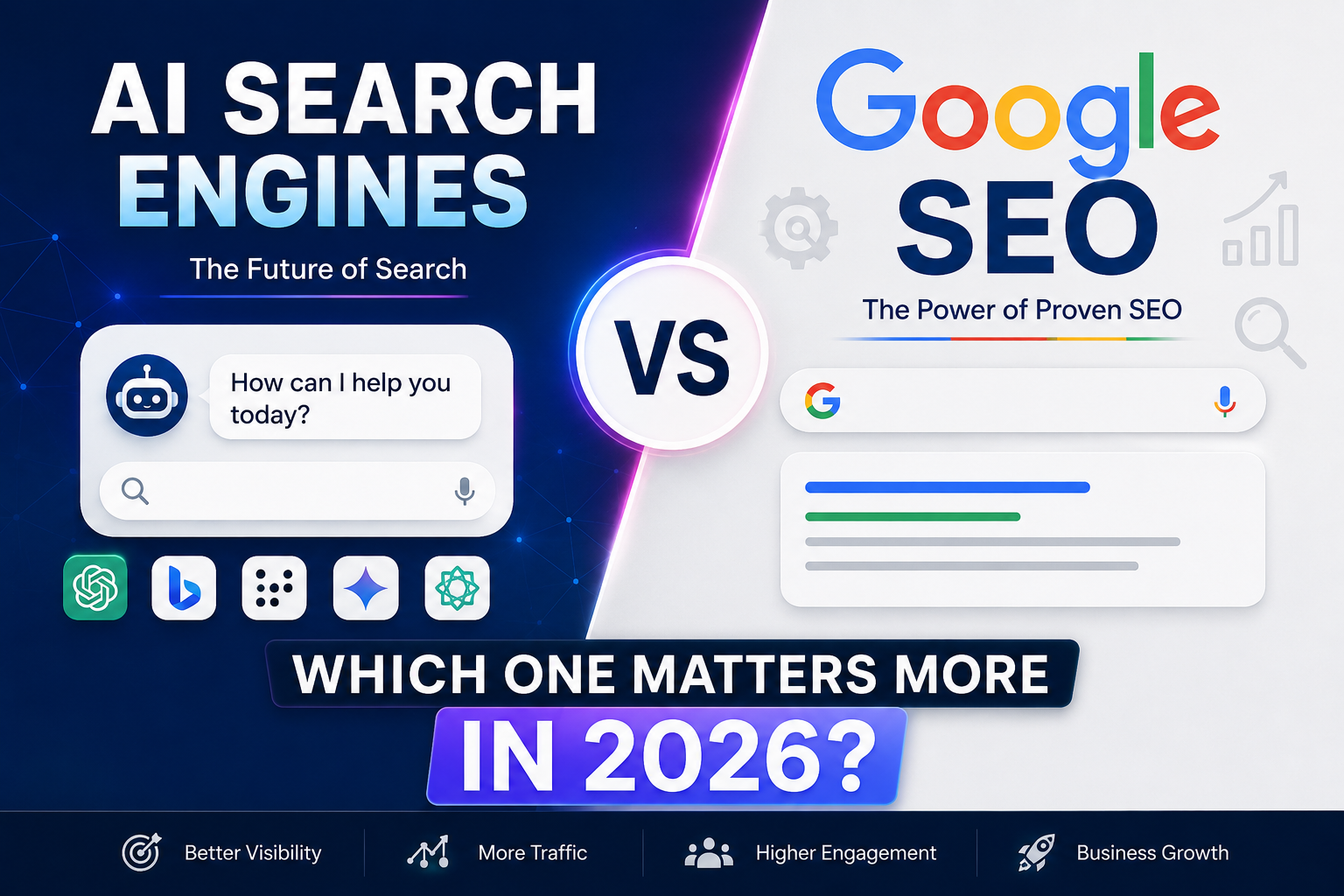
AI Search Engines vs Google SEO: Which One Matters More in 2026?

Introduction
The way people search online is changing faster than ever. For years, Google SEO has been the backbone of digital marketing, helping websites rank through keywords, backlinks, and technical optimization. But in 2026, a new player is reshaping the search landscape: AI search engines.
Platforms like ChatGPT Search, Bing AI, Perplexity AI, and SearchGPT are changing how users discover information. Instead of scrolling through blue links, people now expect direct, conversational answers.
So the big question is: Should businesses focus on AI search optimization or traditional Google SEO?
The truth is, both matter — but in different ways. In this guide, we’ll compare AI search engines vs Google SEO, explain how rankings work on each, and show how businesses can prepare for the future of search.
What Is Google SEO?

Google SEO
(Search Engine Optimization) is the process of improving a website’s visibility in Google search results. It focuses on factors such as:
Keyword optimization
On-page SEO
Technical SEO
Backlinks and authority
Content quality
User experience
Site speed and mobile optimization
Google’s algorithm evaluates millions of pages and ranks the most relevant, authoritative, and useful content for each query.
Key Features of Google SEO
Keyword-based ranking: Content is optimized around specific search terms.
Traffic-driven: The goal is to attract clicks from search results.
Long-term strategy: SEO builds authority over time.
Highly competitive: Millions of websites compete for top positions.
What Are AI Search Engines?

AI search engines use artificial intelligence and large language models (LLMs) to provide direct, conversational answers instead of traditional search result pages.
Popular AI search platforms include:
ChatGPT Search
Bing AI
Perplexity AI
SearchGPT
Gemini (Google AI)
These systems analyze multiple sources, summarize information, and generate human-like responses.
Key Features of AI Search Engines
Conversational answers: Users get direct responses instead of lists of links.
Context-aware search: AI understands intent and follow-up questions.
Source synthesis: Information is pulled from multiple websites and summarized.
Faster user experience: Users often find answers without visiting multiple pages.
AI Search Engines vs Google SEO: The Main Differences
Feature | Google SEO | AI Search Engines |
|---|---|---|
Search style | Keyword-based | Conversational and intent-based |
Results format | List of links | Direct summarized answers |
User behavior | Click and browse | Ask and receive instant answers |
Ranking factors | Keywords, backlinks, authority | Content relevance, clarity, authority, and AI readability |
Traffic flow | Website visits are primary | Website visits may decrease for simple queries |
Optimization focus | Search engine algorithms | AI comprehension and structured content |
Content style | SEO-optimized articles | Clear, concise, and answer-focused content |
How Google SEO Still Dominates

Even with the rise of AI search, Google remains the world’s largest search engine. Billions of searches happen every day, and organic traffic from Google is still a major source of leads and sales.
Why Google SEO Remains Important
Massive audience reach Google still handles the majority of global search traffic.
High commercial intent Users searching on Google are often ready to buy, compare, or take action.
Reliable traffic source Strong SEO can generate consistent long-term traffic without paying for ads.
Brand credibility Ranking on the first page of Google builds trust and authority.
How AI Search Engines Are Changing SEO

AI search engines are not replacing SEO entirely, but they are changing how content is discovered and evaluated.
1. Search Intent Matters More Than Keywords
AI systems focus heavily on understanding user intent. Content that directly answers questions in a natural, conversational way is more likely to be surfaced.
2. Structured and Clear Content Wins
AI models prefer content that is easy to understand and extract information from. This means:
Clear headings
Short paragraphs
Bullet points
FAQs
Direct answers
Structured data
3. Authority and Trust Become Even More Important
AI search engines prioritize trustworthy sources. Websites with strong expertise, accurate information, and credible backlinks are more likely to be referenced.
4. Content Needs to Be AI-Readable
Traditional keyword stuffing no longer works. Content must be written naturally, with semantic relevance and contextual depth.
Which One Should Businesses Focus On?
The smartest strategy in 2026 is not choosing one over the other. Businesses should optimize for both Google SEO and AI search engines.
Focus on Google SEO If You Want:
Consistent organic traffic
Local SEO visibility
E-commerce sales
Lead generation
Long-term search authority
Focus on AI Search Optimization If You Want:
Visibility in AI-generated answers
Brand mentions in conversational search
Early advantage in emerging search platforms
Better alignment with future search behavior
How to Optimize for Both Google and AI Search
1. Create High-Quality, Human-Centered Content
Write content that genuinely helps users. Avoid keyword stuffing and focus on solving real problems.
2. Use Conversational Language
AI search engines favor natural language. Write as if you’re answering a user’s question directly.
3. Structure Content Clearly
Use headings, subheadings, bullet points, and FAQs to make content easy for both users and AI systems to understand.
4. Build Topical Authority
Create multiple related articles around a topic to establish expertise and improve visibility across both search systems.
5. Improve Technical SEO
Fast loading speed, mobile optimization, secure HTTPS, and proper schema markup remain essential.
6. Earn Credible Backlinks
Authority still matters. Quality backlinks help both Google rankings and AI trust signals.
Related Blog Resources
To dive deeper into SEO, AI search optimization, and content strategy, explore these helpful guides:
How to Rank Website in ChatGPT Search Results
Affordable SEO Content Writing Services India
SEO Blog Writing Services for Small Business
Professional Blog Content Writer for Business
On-Page SEO Checklist for Beginners
AI Search Optimization: The Future of SEO in 2026
5 External Resources for More Traffic and Insights
Here are some valuable external links related to SEO and AI search trends:
Google Search Central Documentation
OpenAI Official Website
Microsoft Bing AI Search
Perplexity AI Search
Moz SEO Learning Center
The Future of Search in 2026 and Beyond
Search is becoming more conversational, personalized, and AI-driven. Google itself is integrating AI into search through features like AI Overviews and Gemini.
This means the future of SEO is evolving into something broader:
Traditional SEO
AI Search Optimization
Answer Engine Optimization (AEO)
Entity-based search
Voice and conversational search optimization
Businesses that adapt early will gain a competitive advantage.
Conclusion

AI search engines vs Google SEO is not a battle where one replaces the other. Instead, it’s a shift in how search works.
Google SEO remains essential for traffic, visibility, and business growth. AI search engines are changing user behavior and creating new opportunities for brands to appear in conversational answers.
The winning strategy in 2026 is to:
Create high-quality, user-focused content
Optimize for both search engines and AI systems
Build authority and trust
Use clear, structured, conversational content
Stay updated with evolving search technologies
Businesses that combine traditional SEO with AI search optimization will be best positioned for the future of digital marketing.
Company Website
For professional SEO content writing, AI search optimization, and digital marketing solutions,